Read how I created this series and a little background on the style I developed for it below the photos
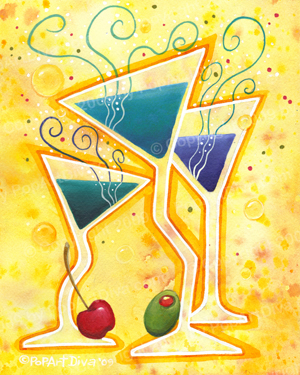 DANCING MARTINIS
Original 8′ x 10″ Acrylic on Watercolor Paper
$125.00 Plus Shipping
Dancing Martinis was the first sketch and the first Martini Art of the series. It was also the one that defined the style of this hand painted watercolor series.
Contact Me to Purchase “DANCING MARTINIS” Original Art
ALSO available on Posters, Tees, Cups, Cards & Other Gear at The Martini Diva Boutique
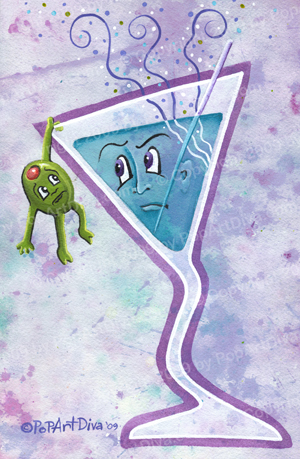 QUIT SCREWING AROUND AND GET ON THE STICK!
Original 6″x12″ Acrylic on Watercolor Paper
$125.00 Plus Shipping
Contact Me to Purchase “GET OFF THE STICK” Original Art
(For some reason when I looked at this leaning martini glass I kept imagining an olive hanging off the rim instead of in the martini itself so I went with it and created this little cartoon illustration!)
—–
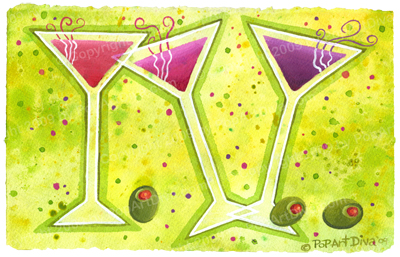 OLIVE A MARTINI, PLEASE
Original 6″x 10″ Acrylic on Watercolor Paper
$125.00 Plus Shipping
The color scheme of this painting uses the tension of opposites on the color wheel – a palette I enjoy using a lot. In order to tie the red-violet martinis in with the yellow-green background, and also tie in the orange of the olives, I made the confetti dots these colors as well as darker olives and greens.
Contact Me to Purchase “OLIVE A MARTINI, PLEASE” Original Art
ALSO Available on Posters, Tees, Cards, Cups, Aprons & other Gear at The Martini Diva Boutique
—-
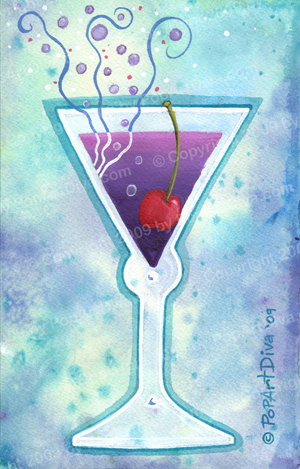 PURPLE NURPLE MARTINI
Original 6″x 10″ Acrylic on Watercolor Paper
$115.00 Plus Shipping
The background here had a lot less of the confetti look so I went with bubbles and swirls here. I love painting bubbles for some reason, lol. BTW, there really is such a thing as a Purple Nurple Martini at The Martini Diva!!
Contact Me to Purchase “PURPLE NURPLE MARTINI” Original Art
—-
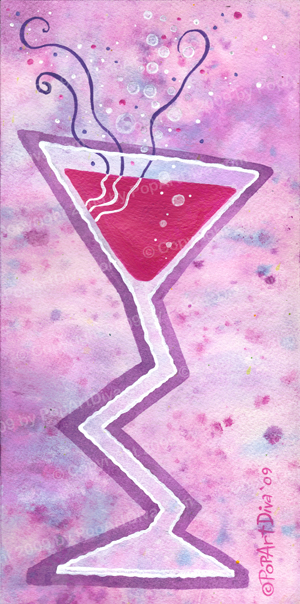 PRETTY IN PINK MARTINi
Original 6″x 12″ Acrylic on Watercolor Paper
$125.00 Plus Shipping
I was going to paint the martini here with greens – the opposite colors palette – but with the little bits of blue in the background I decided to stay in the pinks and violets, using analogous (adjacent) color hues for a change.
Contact Me to Purchase “PRETTY IN PINK” Original Art
————
CREATING THE MARTINI ART ORIGINALS:
I started this series just this last Sunday with a bit of a plan. I wanted backgrounds done in abstract wet-in-wet watercolor style background to incorporate tonal qualities that would create a depth of field from slightly different hues from the same area of the color wheel. Different tone and saturation of the colors would create a visual effect of close-up/far away visually. I am very fond of complementary and split-complementary color palettes, I find them more dramatic and interesting than analogous colors, as well as more complex visually. I’ll even get into Triadic andtetradic color schemes though they can be very tricky. ( Here’s a great tutorial on Color Schemes you might enjoy.)
This type of background is messy work – you wet down the whole sheet and start throwing color on, adding spatters and dropping in some salt for little spots of texture. These also added a confetti look and that is what took me to the style I ended up with.
Originally my plan was to give the glass area a transparent wash of white and then outline the glasses in white – but the white didn’t show up strongly enough against the light to mid-tone backgrounds. At this point it was close to the end of the day and I had to stop painting – it made it a very disappointing day for me. BUT I have learned over the years that a fresh day and a fresh look often solves painting problems and, sure enough, Monday morning I looked at the painting below and realized that I could paint a border around the glasses using the background tones only darker. This would pop them out from the background and be a dark enough contrast to the white glass and outline.
From there the confetti look of the spatters took me to enhancing the “confetti” feel and then adding the fun swirls coming out of the martinis for movement and a whimsical touch. I then added a few more little dabs and dots around the swirls for “effervescence” and to bring in the colors used in the cherries and olives.
Technorati Claim: GC3N9WBMYX2J



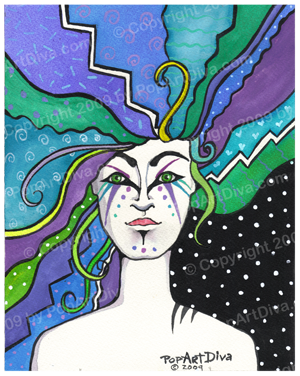 LADY WINGS THE BLUES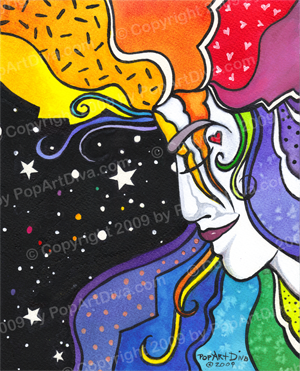
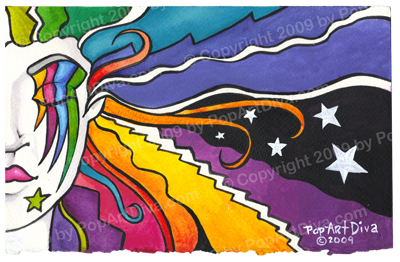 STAR DIVA
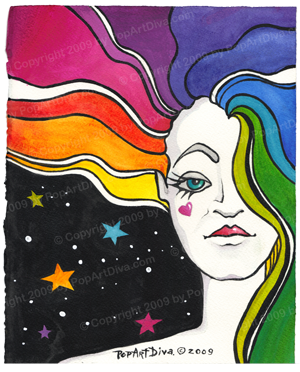 Tallulah
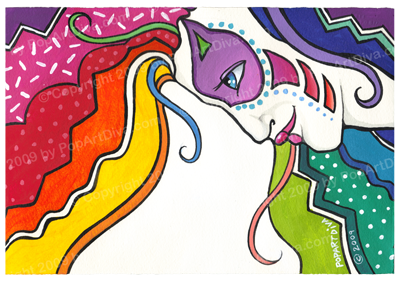 CAT WOMAN
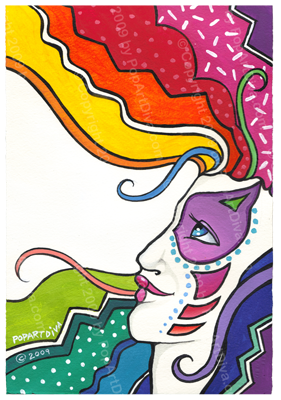 CAT WOMAN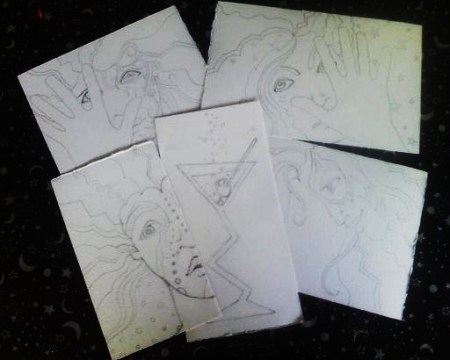
 The Original Art of PopArtDiva